 |

|
Launch of The Biographical Dictionary of the Australian Senate vol 2
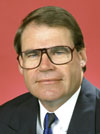
John Faulkner - Leader of the Opposition in the Senate,
Shadow Special Minister of State ,
Shadow Minister for Public Administration and Accountability
|
Speech
Transcript - 16 June 2004
Distinguished guests, ladies and gentlemen.
The Australian Senate is unique among the democracies of the world.
We have:
- equal representation for our states,
- and terms of different dates, and different lengths, to the House of Representatives.
We have:
- democratic elections,
- based on the principle of proportional representation,
- determined by an exhaustive preferential voting system,
- with compulsory attendance at a polling booth.
The launch of this second volume of The Biographical Dictionary of the Australian
Senate is an opportunity for us to look more closely at both the Senate as a crucial
site of democratic practice, and the individuals who have served as Senators.
Their experience was often very different to ours, but our ideas of democracy
are founded on theirs.
Their experience was a Senate and a democracy in transition.
This volume contains the biographies of the one hundred and four Senators who
completed their Senate service between 1929 and 1962. When the first three volumes
of the Biographical Dictionary were conceived, it was necessary to find a rational
way of organising the histories of those Senators who had served between 1901
and 1983.
Given the untidy tendency of Senators to serve terms of anything between 10 days
- Lionel Thomas Courtney, in this volume - and thirty seven years - George Foster
Pearce, also in this volume - the editors have made a logical and sensible decision.
Senators have been allocated to cohorts according to the date they left the Senate,
either by dying - like Senator Courtney, one of 21 Senators of the 104 in this
volume to die in harness - or by retiring, like that long-serving Senator, Defence
Minister, and Labor defector, George Foster Pearce.
This decision, logical as it is, does, however, make for some unusual cohorts,
and perhaps none so much as this one. The 103 men and one woman in this volume
were Senators whose Senate careers finished between the end of the roaring twenties
and the beginning of the swinging sixties.
A time of tremendous change. 1929 was the year of the Black Thursday Stock Market
Crash and the first flight over the South Pole. . 1962 was the year of the Cuban
Missile crisis and John F Kennedy's declaration that humanity would visit the
moon by the end of the decade.
In Australia's parliamentary history, it was also a time of change. There were
a number of very significant electoral reforms. One of the biggest, a little earlier
but affecting the careers of every one of the Senators in this volume, was the
introduction in 1924 of compulsory voting for federal elections.
There must have been some suspicion on the part of the Government of the day
that it wasn't going to be the most popular of their measures. Certainly, Ministers
weren't tripping over each other in their eagerness to take credit. Compulsory
voting was introduced by the passage of a private members' bill - introduced by
one of the Senators in this volume, Herbert Payne of the Nationalist Party. This
Bill essentially made voting in Australia both a right and a duty - and it went
through Parliament in a day!
There were other reforms in this period that affected the Senate only. These
days the Senate is usually divided more or less equally between the major parties
with minor parties holding the balance of power. Whether you think that's a good
thing or a bad thing depends largely on where you stand in the system. But regardless
of political persuasion, I think we can all agree that the current system and
the current outcomes are a vast improvement on the voting system we used to have.
The original first past the post system - under which a number of the Senators
in this volume were elected - produced dramatic swings, such as in 1910 when the
ALP won all 18 seats up for election. In 1919, a block preferential system was
adopted in an effort to remedy the problem. A few years ago I found, in the National
Archives, a letter from the Liberal Senator Burford Sampson, written to Ben Chifley
in support of proportional representation.
He wrote "the present method of election of members of the Senate is about as
bad a voting system as such can be" and he described the results as "grotesque
and unfair" - results such as the 1925 election, when Labor got 45% of the votes
and not a single Senate seat; or 1943, when Labor won 55% of the vote and took
all the Senate spots up for election.
In an effort to repair the block preferential system, compulsory preferences
were introduced in 1934, and of course in 1949, the size of the Senate was increased
to 10 Senators from each state. But the crucial change to the Senate in the last
century occurred in 1949, when proportional voting by the single transferable
vote was introduced for Senate elections. And that really democratised the Senate.
The introduction of proportional representation in 1949 enhanced the status of
the Senate (as Doc Evatt predicted it would), and it has given the Senate a popular
legitimacy it previously lacked.
Proportional representation has made it more difficult for governments to gain
a majority in the Senate, and it has led to more conflicts between the executive
and the Senate - but it has also enhanced the Senate's ability to scrutinize and
improve legislation. The Australian Senate's committee system, and its capacity
to hold governments to account, is the envy of comparable democracies.
At the very end of this period, five years prior to the 1967 referendum, Aboriginal
Australians became entitled to enrol and vote at federal elections, thus completing
the Australian Senate's journey towards legitimacy and democracy.
Ladies and gentlemen, it's fair to say that of the one hundred and four Senators
in this second volume, not one would be a household name and most would be forgotten
to all but students of politics and history.
The first volume included the biographies of many of the 'fathers of federation'.
And we can expect that the next volume will include the biographies of Senators
whose careers came at a time when there were more ministers in the Senate, and
when the shape of politics gave the Senate more opportunities to use or abuse
its powers.
Some of the Senators in this volume really deserve to be better known than they
are. For example, we have Senator Hattil Foll, who served as a Senator for thirty
years from 1917 to 1947 and who served in the military in both WWI and WWII -
including the Gallipoli landing on April 25 1915. Burford Sampson, who I mentioned
before as an advocate of electoral reform, was a Boer War veteran, a WWI veteran
- and a WWII veteran!
The introduction to this volume, penned by Harry Evans, is entitled "Australia's
Senators in the Dark Age of the Twentieth Century". Our Clerk is right. Any age
which includes the Depression and WWII is dark indeed. But one thing that constantly
struck me as I read through the collected biographies was the deep impact of the
Great War.
The effect of military conflict on the Australian political landscape in this
period is most clearly seen when we look at Senators' military service. No currently
serving Senator has seen active service. Of the 104 Senators in this volume, 26
served in WW1, 9 served in WWII, and 8 served in the Boer War. Burford Sampson
was the only Senator to manage the trifecta, but 5 served in both the Boer war
and WWI and 5 more in both WWI and WWII.
If you pick up this volume you will read the years 1929 to 1962 on the cover.
You won't see 1914 to 1918. But the shadow cast by the Great War - the war which
in 1919 was so optimistically thought of as the war to end all wars - was a long
one.
Even the Senators who didn't see active duty in WWI had brothers, fathers, sons,
cousins and friends who did go to war - some never to return. One of the most
poignant of the stories in this volume is that of Senator Arthur Rae, a fervent
anti-conscriptionist who lost two sons in the Great War.
Ladies and Gentlemen, in recent years we've often heard media critics talk about
the rise of a political class - as if taking up the profession of politics as
a career is a deplorable innovation. This volume shows there is nothing new to
Australian Parliaments in the professional politician. Of the 104 senators in
this particular volume, a total of 37 were also State Parliamentarians. Twelve
served in the House of Representatives as well as the Senate. Those figures include
two Senators who served in both the House and Representatives and in State Parliaments,
as well as the Senate. Compare that to the current Senate, where of 76 Senators
only one has served in the House of Representatives, and only four in state parliaments
or territory assemblies.
Of course, I don't think any of us could be expected to meet the record of James
Arkins, who represented four separate state seats, three before becoming a Senator
and one after; or Michael O'Halloran, who won the state seat of Burra Burra for
Labor in 1918, lost it in 1921; won it again in 1924, then went to the Senate
to represent SA Labor there, and then, after leaving the Senate, stood for the
state seat of Fromme and held that seat for another 22 years.
Michael O'Halloran's parliamentary career was a long one - seven years in the
Senate plus 28 years in State parliament. This volume also tells the story of
an even longer parliamentary career - that of George Foster Pearce, 37 years a
Senator - the longest ever. In the ALP, we regret that so much of Pearce's long
career was spent as a non-Labor representative. His decision to follow Billy Hughes
in the conscription split was a blow to the ALP but, perhaps, also to Pearce himself.
As Peter Heydon said in Quiet Decision, his biography of Pearce, "His later successes
never quite healed the wounds of conscription. He never seemed quite so purposeful
or authentic again …"
Ironically for a Minister whose career would be so defined by his support for
including conscripts in the army, Pearce's greatest legacy was the professionalisation
of the Australian Defence Forces, which he began immediately after becoming Minister
for Defence.
He was passionately opposed to 'bought commissions' and 'family regiments'. He
ensured that cadets in both the Royal Military College and the Royal Australian
Naval College were paid, so that the officers of Australia's armed forces could
be drawn from the best and most able, regardless of their parent's financial means.
He was also determined to get hard work from all ranks, and used to proudly tell
the story of a General cured of the habit of late arrival by finding a note on
his desk: 'Please see me urgently. G.F.P. 9.15am'.
Senator Sir George Pearce was one of ten Senators in this volume to have been
knighted and one of just four Senators, and the only one in this volume, to have
a Federal electorate carry his name. Some of the Senators in this volume, though
largely forgotten, are remembered in weird and wonderful ways. Believe it or not,
the primary school my kids attended, the Forest Lodge Public School in Glebe,
has a sports house named 'Robertson' - after Senator Agnes Robertson, who represented
Western Australia for the Liberal Party and the Country Party. She attended Forest
Lodge Public School as a student although she was born in South Australia.
Senator Robertson is the only woman Senator in this volume - not the first woman
elected to the Senate, but the first to retire from it. She was not elected until
she was sixty-seven years of age, with a long teaching career and union work behind
her. In 1955 the Liberals dropped her from their ticket because they considered
her too old. She promptly transferred her allegiance to the Country Party, who
did not consider her too old to get first place on their ticket. After all, they
had the precedent of South Australian Labor Senator Frederick Ward - first elected
in 1947 at the age of 75!
Senators in this volume were a much more mature group than their counterparts
of today. Their average age on entering the Senate was 51 compared with 41 for
our current Senators. Of those who entered the Senate between 1920 and 1950, some
22 were in their sixties and 2 in their seventies. Today only one Senator began
his Senate career after his 60th birthday.
The indefatigable Senator Robertson campaigned relentlessly for her newly adopted
Country Party, and was narrowly victorious. She served out her full term until
she finally retired, aged 80.
No-one should tell Peter Costello about Agnes Robertson's Parliamentary career!
Agnes Robertson is not the only Senator in this volume with a connection to Glebe.
Senator Arthur Rae, who represented NSW as an ALP and later Lang Labor Senator,
was among those sent by NSW Head Office to try and bring Glebe Branch back into
line during the Great Glebe Branch Revolt of 1911.
I'll just read an extract from 'Local Labor', the story of the ALP in Glebe,
about what happened when he turned up at the Branch: "This was not calculated
to bring about a peaceful resolution, and the meeting turned into a near riot,
before it ended in chaos," writes Michael Hogan. Newspaper accounts of the meeting
state: "Senator Rae and Mr Kohen were bustled and struck while going out of the
room, and the latter drew a revolver to protect himself. A man in the hall grasped
the muzzle of the revolver, and thereby turned it towards himself, and ultimately
it was secured by a tactful police constable, whose pacific but capable way of
handling a crowd which threatened to run riot, was deserving of great praise."
So with that local background to Arthur Rae, I was not surprised to discover
that he was the first Senator to be suspended from the Senate on the 1st of November
1912. During debate, Senator Millen from the NSW 'Anti-Socialist Party' characterised
Arthur Rae's comments as "an open and avowed declaration of anarchy". Senator
Rae called him a liar, and refused to withdraw the comment until Senator Millen
withdrew his.
Senator Rae was thrown out of the chamber, thus setting two precedents - one
dubious, one exemplary. While I regret that a Labor man was the first to be suspended
from the Senate for a breach of standing orders, I am proud of my Party's tradition
of its Senators defending their beliefs and policies against the slurs of our
opponents.
But while Senators may vigorously defend their beliefs, it falls to the Parliamentary
officers to defend the dignity of the Senate. In this volume of the Biographical
Dictionary of the Australian Senate we read of three Clerks who filled that role
- George Monahan, Robert Broinowski and John Edwards. Broinowski seems to have
been particularly scrupulous in defending the dignity of Parliament. On one occasion,
he banished poppy-sellers from the parliamentary precincts - on Remembrance Day!
On another occasion, Broinowski found it necessary to prohibit the playing of
ping-pong within Parliament House. This inspired some wonderful words from C.J.
Dennis:
"Oh, his brows were wreathed with thunder as he gazed in stupid wonder,
As he heard the sinful pinging and the sacrilegious pong.
And he said, 'Henceforth I ban it. If I knew who 'twas began it
I would have him drawn and quartered, for 'tis obviously wrong.'
Then back adown the corridors, unbending as a god,
Went the adamantine Usher of the Big Black Rod."
Richard Hughes of the Sunday Telegraph described the Senate in Broinowki's time
as 'A comfortable Home for Old Men', presided over by the President but ruled
by the Clerk (Broinowski) - 'a thin querulous fellow, with a beaky nose, light,
angry eyebrows, and a small wig. He hisses acid instructions and advice to the
timid Senators like a bad- tempered stage prompter'. Now Harry - don't get any
big ideas! As a result of the article, Richard Hughes and four of his press colleagues
were banned from Parliament House for several months.
Ladies and Gentlemen, this second volume of the Biographical Dictionary of the
Australian Senate continues a very valuable work of scholarship. Although it sometimes
feels in contemporary politics that politicians are scrutinised relentlessly,
we know relatively little about our predecessors in Parliament. The Biographical
Dictionary is an essential reference for anyone looking for information about
past Senators. Ann
Millar and her team deserve great credit for the comprehensive detail they have
included, and for the readability of the style throughout.
I said earlier that the Senators in this volume experienced a Senate and a democracy
in transition. In both their public careers and their private lives, they lived
through an almost incomprehensible series of shocks.
Think of Agnes Robertson, a young wife in 1911, a single working mother with
three small children in 1913, and a Senator in 1950. Think of George Foster Pearce,
who saw his dream of a unified Australia and an Australian Labor Government realised,
before helping to destroy that Labor Government over one of the most bitterly
divisive political questions Australia has ever faced. Think of Burford Sampson
and his active service in three wars; or Arthur Rae, most hard-line of the loyal
anti-conscriptionists in 1917, who sent three sons to war and only welcomed one
home - and then himself became a Splitter from the Labor Party himself in 1931.
As individuals and as members of Parliament, the Senators in this volume did
more than endure these changes. They adapted their ideas - and the Senate - to
meet the demands of their tumultuous times. They may never be household names, but this volume of the Biographical Dictionary
of the Australian Senate will ensure they are much better known than they are
now, and their lives and achievements will receive the recognition they deserve.
Ends. Check Against Delivery
|




 Email
Email
 Print
Print